
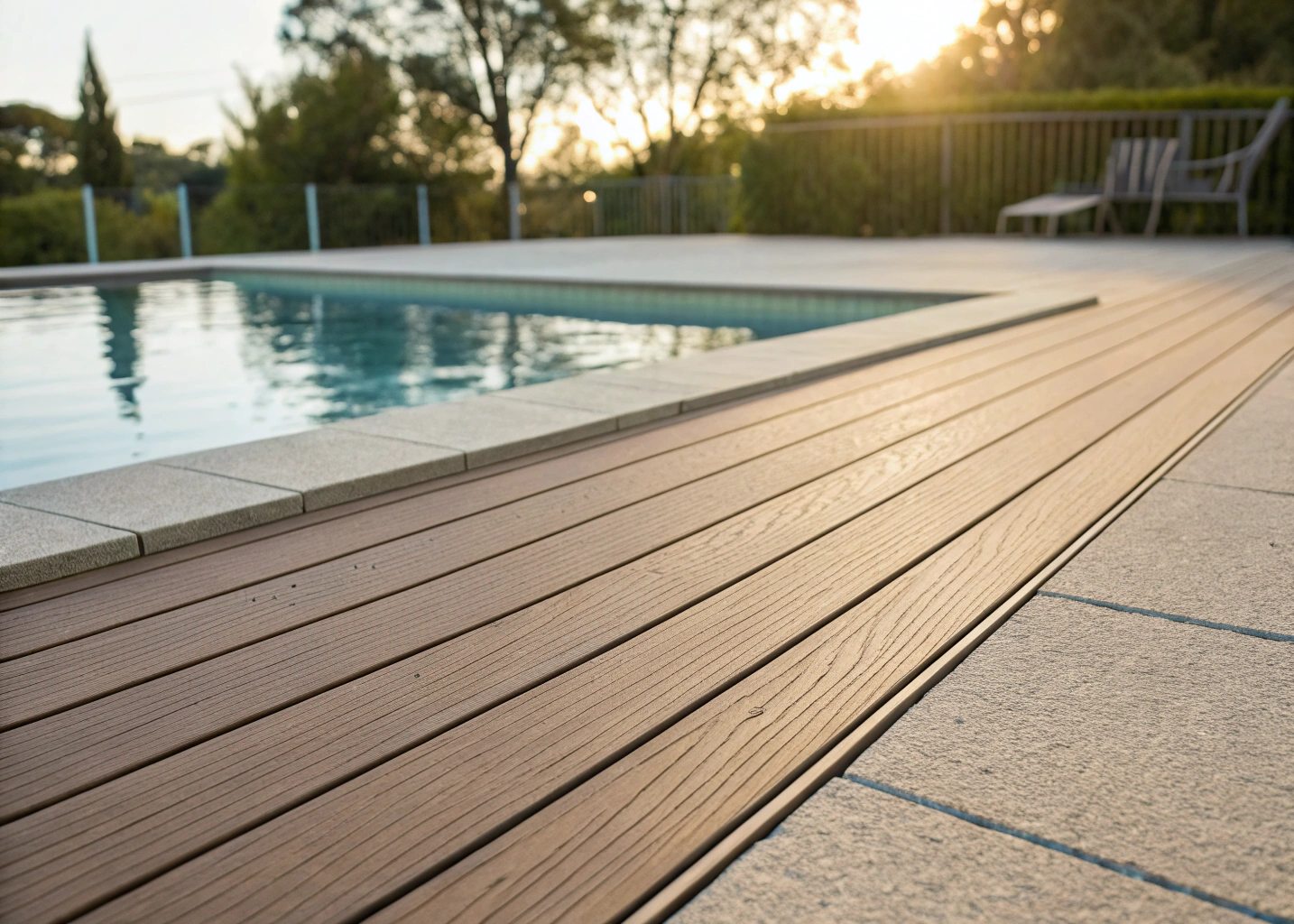
What is the best decking material for around a pool?
The best pool decking material for Adelaide homes depends on your priorities, but timber and composite are the two most practical choices for the local climate.
- Composite pool decking — moisture-resistant, splinter-free, and low maintenance. Engineered surface profiles provide slip resistance when wet, making it the preferred choice for high-use pool environments in Adelaide’s UV-intense summers
- Hardwood timber decking — naturally beautiful and proven in outdoor conditions when correctly selected and maintained. Species like spotted gum offer natural slip resistance when wet and perform well around pools with correct gapping, oiling, and drainage design
- Both materials require correct board gapping, engineered falls, and proper drainage to perform safely around water
- Material selection should account for Adelaide’s heat load — composite board colour and profile selection affects surface temperature performance

Why Pool Decking Is a Different Beast to Standard Decking
Standard backyard decking gets wet when it rains. Pool decking gets wet every single day — and that distinction compounds into an entirely different set of demands.
The pool environment layers conditions that standard decking never faces simultaneously. Constant moisture cycling puts repeated stress on boards, fixings, and the subframe beneath. Pool chemicals accelerate the degradation of anything not engineered for that exposure. Adelaide’s summer UV is unforgiving on surface finishes and fixing points. And every person stepping off that deck is doing it barefoot, wet, and often moving fast — which makes slip resistance a baseline requirement, not an optional feature.
Standard decking can get away with a lot. Pool decking can’t. The margin for error on material selection, board gapping, drainage falls, and surface profile is much smaller — because the consequences show up faster and carry a genuine safety risk.
Timber Pool Decking — Species, Performance, and What Adelaide's Climate Demands
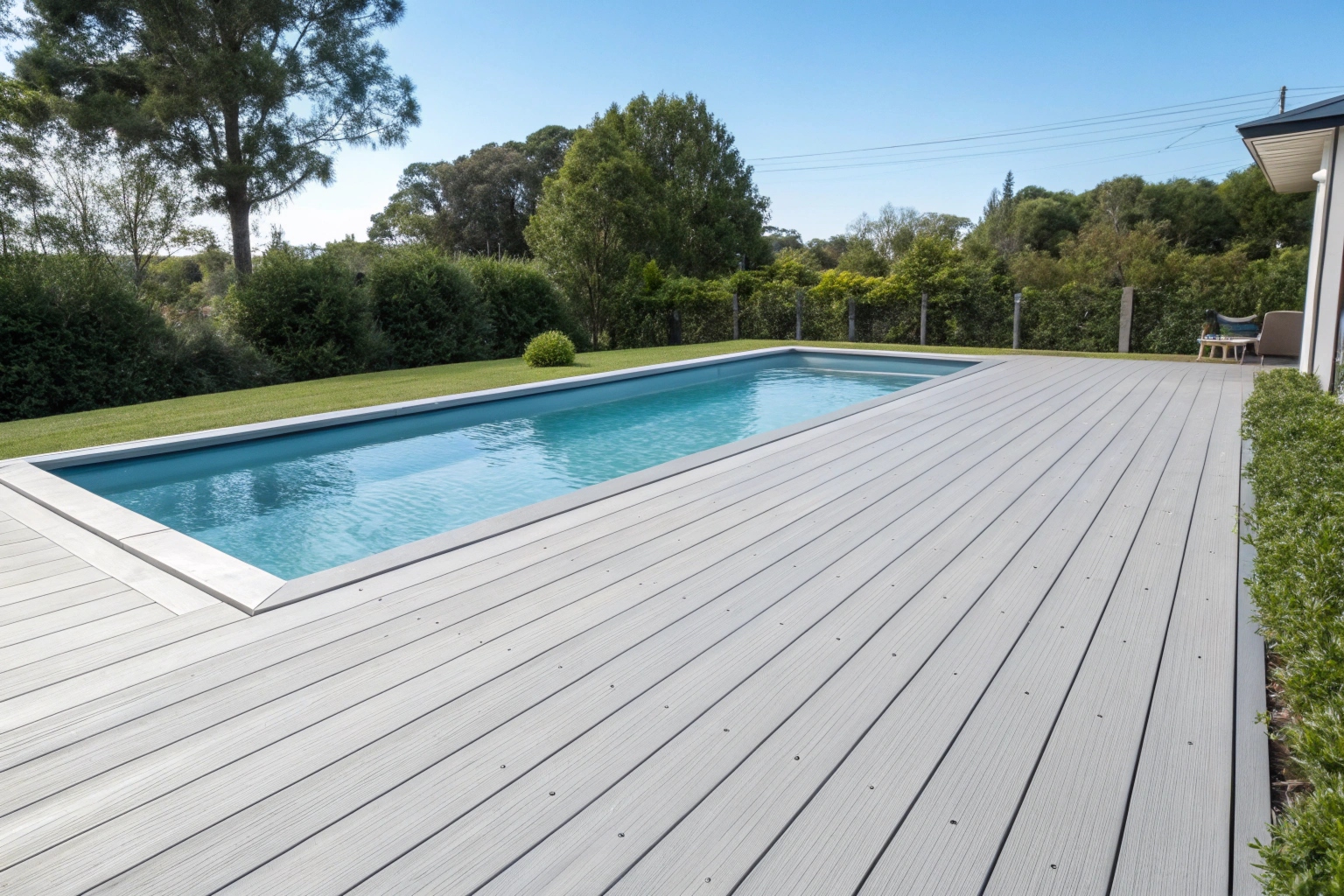
Composite Pool Decking — Why It's Becoming the Default Choice
Moisture Resistance and Chemical Compatibility: Composite boards don’t absorb moisture. No swelling, no cupping, no degradation from chlorine or saltwater contact — it handles the pool environment by design, where timber requires ongoing maintenance to achieve the same result.
Slip Resistance and Barefoot Safety: Composite boards are manufactured with engineered surface profiles — groove patterns and embossed textures built into the board that maintain grip when wet. It’s not a coating that wears off. It performs consistently through Adelaide’s high-use summer pool season, and for households with kids it’s often the deciding factor.
Low Maintenance in a High-Punishment Environment: No oiling. No sealing. No sanding. Composite pool decking needs a periodic wash-down and very little else. For a surface taking daily punishment through Adelaide’s long summers, that low maintenance reality is a significant part of why it’s become the default choice for new pool surrounds.
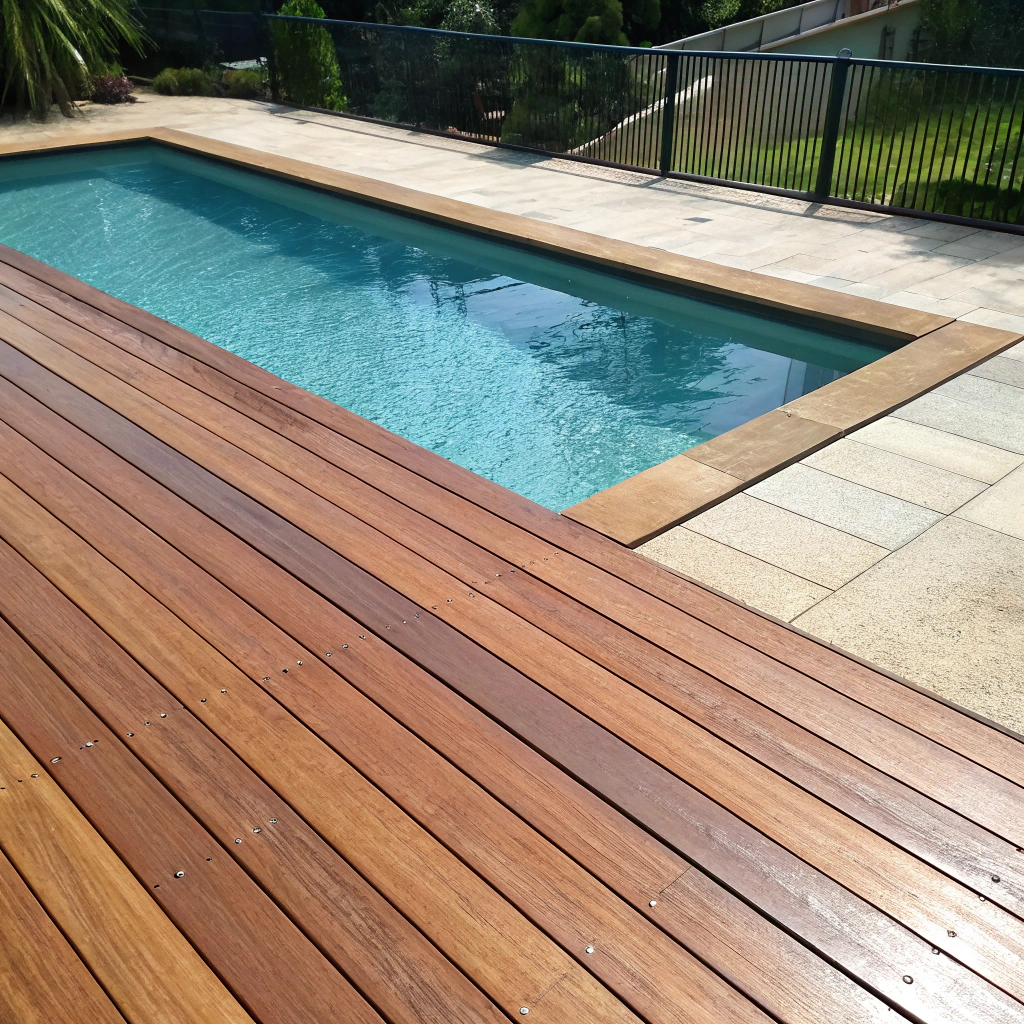
Designing Your Pool Deck — Layout, Board Direction, and Coping Details
How the Deck Wraps the Pool: Pool deck layout involves more decisions than most homeowners expect. Full wrap or partial deck, board direction relative to the pool edge, and how the deck meets the existing coping or pool edge treatment all affect both the visual result and the way the surface performs. Board direction in particular changes how the space reads — running boards parallel to the pool’s longest edge tends to elongate the space, while perpendicular layouts suit wider surrounds.
Falls, Drainage, and Surface Water Management: Water on a pool deck needs somewhere to go — away from the pool and away from the subframe below. Engineered falls built into the subframe direct surface water off the deck efficiently. Without them, water pools on the surface, accelerates material degradation, and creates the slip risk the deck was designed to prevent in the first place.
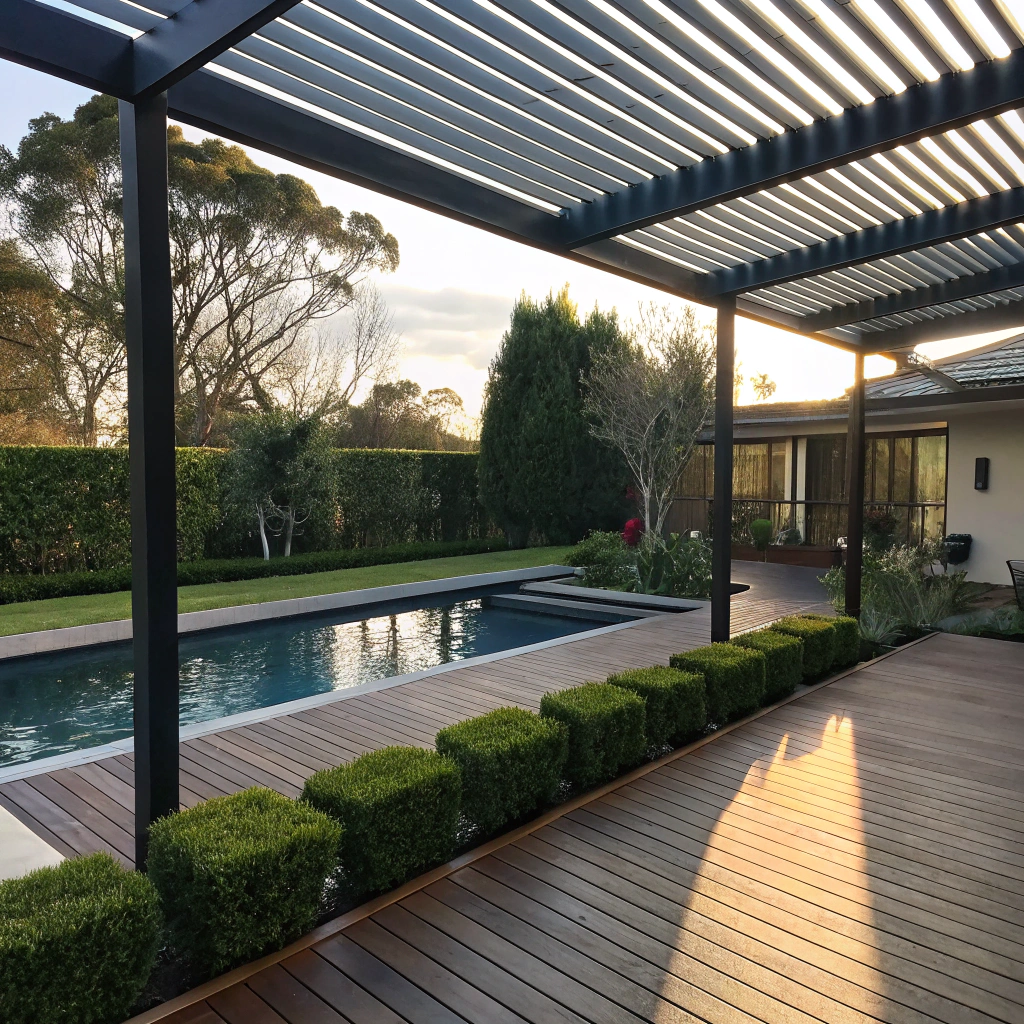
Adding a Pergola or Shade Structure Over the Pool Area
Given Adelaide’s UV intensity, a pergola or shade structure over the pool area is one of the most common project combinations we see. The integration works well — but only when both elements are designed together from the outset.
Post footing placement for any overhead structure has to be coordinated with our deck subframe layout before installation begins. Retrofitting a pergola to an existing pool deck frequently creates structural conflicts — footings land where subframe members run, or post positions compromise the deck layout in ways that are expensive to resolve after the fact.
Clients who want both a pool deck and an overhead structure get a better outcome when we scope and design both together in a single project. It removes the conflicts, keeps the build sequence clean, and delivers a finished pool area that functions and looks like it was always meant to work as one.
Pool Decking Across Adelaide — Conditions, Suburbs, and What We See on Site
Adelaide’s conditions make pool decking more demanding than most other Australian markets. UV intensity through the November to March stretch is severe. Summer heat loads affect how boards perform at surface level — composite board colour and profile selection matters more here than in cooler climates. For properties in coastal suburbs like Glenelg, Brighton, and Marino, salt air adds another layer of material stress that factors into what we recommend.
In the northern growth corridors — Angle Vale, Munno Para, Blakeview — we regularly work with new builds where the builder has left a blank slab and the pool surrounds are completely exposed through summer. Material recommendations shift depending on site conditions, block orientation, and sun exposure. What works on a south-facing Burnside property reads differently on a north-facing new build in Munno Para. Local knowledge changes what we specify and how we build.
How We Deliver Pool Decking Projects — Process, Timeline, and What to Expect
- Site measure and design consultation — we visit the site, assess the pool surround, discuss material options, and take measurements. This is where layout decisions, board direction, and falls engineering get scoped.
- Material selection — we walk you through timber and composite options suited to your site conditions, sun exposure, and how the pool area gets used.
- Permit and compliance check — where council notification or building consent applies, we identify this early and handle the relevant steps before installation begins.
- Subframe construction and falls engineering — the subframe is built with engineered falls that direct surface water away from the pool and the structure below.
- Board installation and coping detail — boards are installed with correct gapping, fixings, and finish at the pool edge and coping interface.
- Final inspection — we walk through the finished deck with you before we leave the site.
Frequently Asked Questions
What's the difference between pool decking and standard decking?
Pool decking is built for constant moisture, chemical exposure, and barefoot safety. It requires specific materials, engineered drainage falls, correct board gapping, and slip-resistant surface profiles that standard backyard decking simply doesn’t need.
Do you supply and install, or installation only?
We handle both. We supply the timber or composite boards and complete the full installation — subframe, falls engineering, board laying, and coping detail.
How long does a pool deck installation take?
Most residential pool surrounds take between three and five days depending on size and complexity. We’ll give you a clear timeline before work begins.
What's the best material for a pool deck in Adelaide?
It depends on your priorities. Composite is lower maintenance and handles Adelaide’s conditions with minimal upkeep. Hardwood timber like spotted gum looks beautiful and performs well when maintained correctly. We’ll recommend the right option for your site after the initial measure.
Do I need council approval for a pool deck in Adelaide?
In many cases a pool deck doesn’t require a separate building consent, but it depends on the size, height, and how it interacts with your pool fencing compliance. We check this during the initial consultation so there are no surprises.
How do I maintain a timber pool deck?
Timber pool decking needs oiling every six to twelve months depending on sun exposure and pool chemical contact. Regular oiling keeps the surface sealed and prevents the cracking and splintering that comes with neglect in Adelaide’s conditions.
Does composite decking get too hot to walk on barefoot in Adelaide summers?
Some composite boards do retain heat in direct sun. Board colour and profile selection makes a difference — lighter colours and grooved profiles perform better in high heat load conditions. We factor this into our material recommendations for Adelaide sites.
Can you integrate pool fencing into the deck design?
Yes, and we’d encourage you to plan both together from the outset. Post footing placement and barrier continuity need to work with the deck subframe — coordinating both from day one avoids costly rework later.
Can you add a pergola over the pool deck as part of the same project?
Absolutely. It’s one of the most common combinations we deliver. When both are scoped together, post footings and the deck subframe are coordinated from the start — which gives a cleaner result than retrofitting a pergola to an existing deck.
Ready to Plan Your Pool Deck?
We offer a free measure and quote for pool decking installations across greater Adelaide. Get in touch with our team to discuss your project — no pressure, no obligation.
Call us: 08 8246 5424
Serving homeowners across greater Adelaide — we’ll respond within one business day.
What happens next:
- Get in touch for your free measure and quote
- We visit your site, discuss materials, and provide a detailed proposal
- Installation is scheduled at a time that suits your household
